JETT is an electrical energy-based technology that can be used through two distinct applicators, each producing a different physical and biological effect.
The gold tip produces a controlled plasma effect, whereas the silver tip delivers low-intensity electrical energy that may modulate cell membrane polarization and associated cellular signaling.
These two modes should be clearly distinguished, as they do not act through the same mechanism and may be selected according to the clinical target.
Two distinct applicators
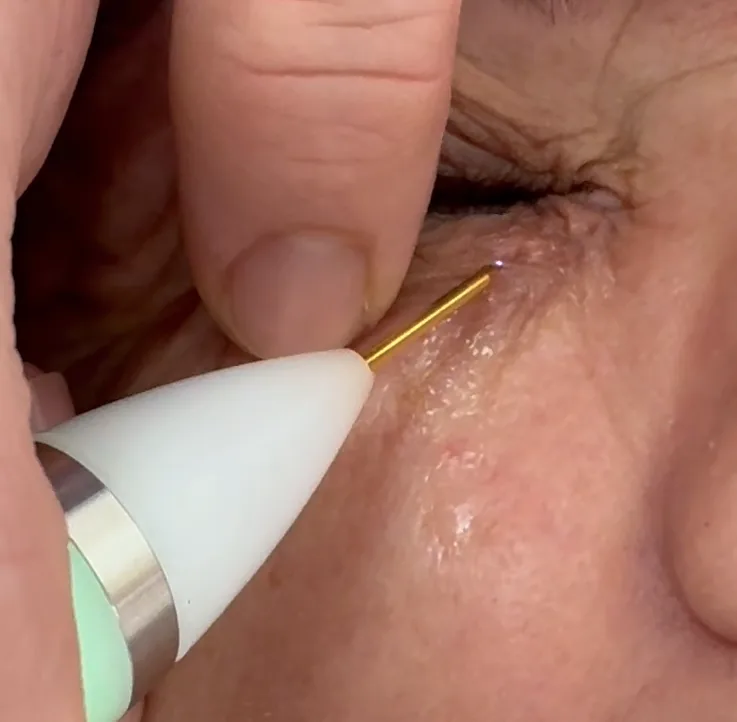
Gold tip: controlled plasma effect
The gold tip generates a localized plasma effect through controlled electrical discharge.
This mode allows precise treatment of superficial periocular tissues and selected areas of the ocular surface environment.
Its clinical use is based on a localized, non-contact or near-contact plasma effect, depending on the treatment protocol and indication.
The objective is to produce a controlled local tissue effect while limiting treatment to the selected area.
Silver tip: low-intensity electrical effect
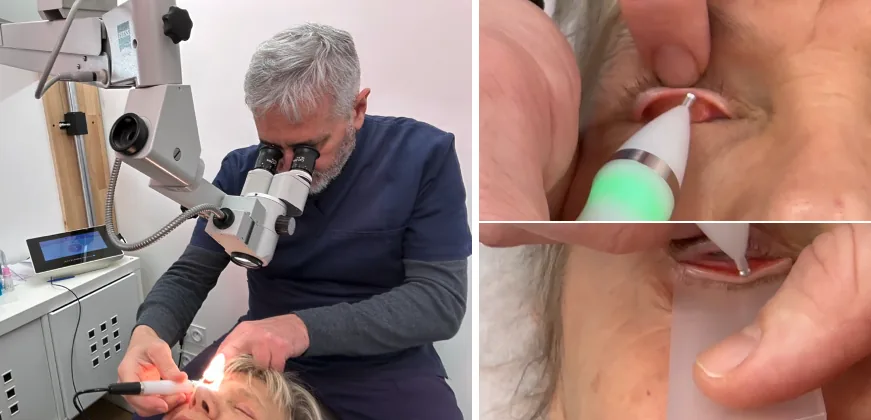
The silver tip does not produce plasma.
It delivers low-intensity electrical energy directly to the treated tissues.
This electrical stimulation may influence cell membrane polarization, transmembrane electrical gradients, and associated cellular signaling, potentially modifying local biological responses without producing an ablative plasma effect.
The silver-tip mode should therefore be considered an electrical cellular modulation approach, distinct from the plasma effect generated by the gold tip.
Important: JETT is not an electroporation device
The term electroporation should not be used to describe the mechanism of action of the JETT silver-tip applicator.
Reversible electroporation requires specific electrical field strengths and pulse characteristics capable of producing transient aqueous pores within the cell membrane.
The electrical parameters delivered by JETT do not meet the established criteria required to induce reversible electroporation.
The silver-tip effect should therefore be described more appropriately as a low-intensity transmembrane electrical effect that may modulate membrane polarization and cellular signaling.
JETT silver-tip treatment involves electrical membrane modulation, not reversible electroporation.
Why the distinction matters
The two JETT applicators should not be considered interchangeable.
Controlled plasma effect
Low-intensity electrical effect
The choice of applicator depends on the anatomical target, the intended biological effect, and the clinical indication.
This distinction is essential for understanding the role of JETT within Interventional Dry Eye and for avoiding confusion between fundamentally different mechanisms.
JETT in dry eye disease
JETT is used within the WIDES Interventional Dry Eye approach as an adjunctive technology for selected patients in whom conventional treatment alone may not adequately address the predominant pathological mechanisms.
Its potential clinical interest is particularly considered in patients presenting with significant ocular surface involvement, inflammatory disease, severe meibomian gland dysfunction, or complex mixed-mechanism dry eye.
Patient selection should always be based on a complete diagnostic assessment.
Current WIDES clinical indications
Based on current WIDES clinical experience and on the proposed biological mechanisms of the technology, JETT may be considered in selected cases including the indications listed below.
These eight indications reflect both current WIDES clinical practice and mechanistic hypotheses. They should not be interpreted as universally established or regulatory-approved indications, and several of the proposed mechanisms, particularly accessory lacrimal gland and conjunctival goblet-cell stimulation, require further prospective clinical validation.
-
01
DED with significant corneal epithelial damage
Patients with clinically significant ocular surface involvement and persistent corneal epithelial abnormalities despite conventional treatment.
-
02
DED with conjunctival involvement
Patients presenting with significant conjunctival epithelial or inflammatory changes as part of the ocular surface disease.
-
03
Severe ocular rosacea
Patients with marked inflammatory and vascular involvement, particularly when ocular rosacea contributes substantially to the dry eye phenotype.
-
04
DED with advanced meibomian gland atrophy
Selected patients with severe structural meibomian gland loss in whom conventional gland-directed treatments may have limited potential because of the reduced amount of remaining functional glandular tissue.
-
These indications represent WIDES clinical practice and experience rather than universally established indications and should be interpreted accordingly.
-
05
DED with lid wiper epitheliopathy (LWE)
Patients with clinically significant Lid Wiper Epitheliopathy, reflecting increased friction and mechanical stress at the interface between the eyelid and ocular surface.
LWE is extremely common in symptomatic dry eye patients and has been reported in some clinical series in up to approximately 95% of symptomatic individuals. Its presence may therefore represent an important marker of friction-related ocular surface disease and a relevant therapeutic target within a multimodal Interventional Dry Eye strategy.
-
06
Transcutaneous stimulation of the orbicularis oculi muscle
Selected patients with incomplete or inefficient blinking in whom transcutaneous electrical stimulation of the orbicularis oculi muscle may help improve blink dynamics and support ocular surface protection.
Periorbital transcutaneous electrical stimulation has been proposed to enhance blinking through neuromuscular mechanisms and may represent a useful adjunct in selected DED patients.
-
07
Stimulation of the accessory lacrimal glands of Krause and Wolfring
Electrical stimulation may potentially support the activity of the accessory lacrimal glands of Krause and Wolfring, which contribute to aqueous tear secretion.
This approach is of particular clinical interest in Sjögren-related DED, where stimulation of residual lacrimal secretory capacity may represent an additional therapeutic strategy within a multimodal approach.
The accessory lacrimal glands form part of the lacrimal functional unit and contribute to tear production, although their exact quantitative contribution remains incompletely defined.
-
08
Stimulation of conjunctival goblet cells
Conjunctival goblet cells play a central role in ocular surface homeostasis through the production and secretion of tear-film mucins, particularly MUC5AC.
Low-intensity electrical stimulation may potentially influence goblet-cell bioelectrical activity and cellular signaling, with the therapeutic objective of supporting mucin secretion and restoration of the mucous component of the tear film.
This indication is particularly relevant in patients with significant conjunctival involvement or evidence of mucin deficiency, although the specific effects of JETT on conjunctival goblet cells remain under investigation.
JETT within a multimodal strategy
JETT should not be considered a universal stand-alone treatment for dry eye disease.
Its role is to complement other therapeutic approaches when the patient's pathophysiological profile suggests that additional local tissue or electrical modulation may be useful.
Depending on the clinical situation, JETT may be integrated with:
- Intense Pulsed Light
- Quantum Molecular Resonance
- Photobiomodulation
- Meibomian gland expression
- Topical anti-inflammatory therapy
- Ocular surface regenerative treatments
JETT is one component of a multimodal treatment strategy, not a replacement for accurate diagnosis and mechanism-based treatment selection.
JETT within the Interventional Dry Eye Concept
Within the WIDES Interventional Dry Eye protocol, JETT has become a central and increasingly indispensable component of the therapeutic strategy.
Its particular value lies in the availability of two distinct treatment modes, and especially in the silver-tip applicator, which introduces a therapeutic mechanism that is fundamentally different from the effects obtained with IPL, photobiomodulation, thermal therapies, mechanical gland treatments, or other energy-based technologies.
The silver tip delivers low-intensity electrical energy that may modulate cell membrane polarization, transmembrane electrical gradients, and associated cellular signaling. In current WIDES clinical experience, this mode can produce clinical effects in selected patients that are not obtained in the same way with other technologies currently used within the Interventional Dry Eye protocol.
This unique therapeutic dimension is particularly relevant when dry eye disease extends beyond meibomian gland obstruction and vascular inflammation to involve the corneal and conjunctival epithelium, lid wiper, neuromuscular function, accessory lacrimal glands, or conjunctival goblet cells.
A patient may simultaneously present with:
- epithelial damage
- inflammation
- vascular abnormalities
- gland obstruction
- severe gland atrophy
- tear-film instability
- mucin deficiency
- lacrimal dysfunction
- abnormal blink dynamics
Other interventional technologies remain essential for targeting complementary mechanisms, but JETT, particularly through the silver-tip mode, adds a distinct electrical cellular-modulation component to the multimodal strategy.
For this reason, JETT should not simply be viewed as another device within the therapeutic armamentarium. Within the WIDES approach, it has become a key technology for addressing pathophysiological components of DED that may remain insufficiently targeted by other interventional modalities.
Clinical take-home message
JETT combines two distinct therapeutic modalities within a single platform, providing a unique place within the Interventional Dry Eye strategy.
The gold tip produces a controlled plasma effect, while the silver tip delivers low-intensity electrical energy that may modulate cell membrane polarization, transmembrane electrical gradients, and associated cellular signaling.
The silver-tip mechanism should not be described as electroporation, because the electrical parameters required to induce reversible electroporation are not reached.
Within the WIDES approach, the particular value of JETT lies in the silver-tip mode, which introduces a therapeutic mechanism that differs fundamentally from IPL, photobiomodulation, thermal therapies, radiofrequency, and mechanical gland treatments.
In selected patients, this electrical cellular-modulation approach may address components of dry eye disease that are not targeted in the same way by other interventional technologies, including epithelial dysfunction, lid-wiper involvement, neuromuscular dysfunction, accessory lacrimal gland dysfunction, and conjunctival goblet-cell impairment.
For this reason, JETT has become a key component of the WIDES Interventional Dry Eye protocol, particularly when dry eye disease extends beyond gland obstruction and vascular inflammation.