Quantum Molecular Resonance (QMR) is a non-invasive, energy-based technology delivering low-intensity oscillating electrical fields without significant tissue heating.
Unlike thermal therapies, QMR is not primarily designed to heat the eyelids or mechanically evacuate the meibomian glands. Its biological rationale is based on non-thermal electrical stimulation of cellular and tissue processes, with potential effects on cellular metabolism, inflammatory pathways, tissue repair, and meibomian gland function.
Within the WIDES Interventional Dry Eye Concept, QMR has acquired a particularly important role because it addresses a component of DED that is not the primary target of most gland-directed technologies: the damaged corneal epithelium.
How QMR works
QMR delivers low-intensity oscillating electrical fields to ocular and periocular tissues.
The treatment is designed to induce biological effects without conventional thermal tissue damage.
Proposed mechanisms include modulation of:
- cellular metabolism;
- bioelectrical cellular activity;
- inflammatory pathways;
- tissue repair processes;
- meibomian gland metabolism;
- ocular surface homeostasis.
The 2026 network meta-analysis describes QMR as a non-thermal, low-intensity electrical technology intended to stimulate cellular regenerative processes and enhance meibomian gland metabolism without significant tissue heating.
QMR is not primarily a heating technology. Its particular interest lies in non-thermal electrical biological stimulation.
A particularly important effect on the corneal epithelium
Corneal staining as an objective marker of epithelial damage
Corneal fluorescein staining is an objective marker of corneal epithelial damage in dry eye disease.
It directly reflects the consequences of tear-film instability, inflammation, friction, hyperosmolarity, and chronic ocular surface stress on epithelial integrity.
Reduction in corneal staining therefore represents much more than symptomatic improvement: it provides objective evidence that the condition of the corneal surface is improving.
This is where QMR has demonstrated a particularly remarkable clinical effect.
Key 2026 evidence
QMR ranked first for improvement in corneal staining
In 2026, Noyman, Mimouni and colleagues published a systematic review and random-effects network meta-analysis comparing technological interventions for dry eye disease at 2-4 months (Noyman DBE, Chan CC, Teichman JC, Arbel I, Yosefi O, Myerscough J, Mimouni M, Safir M. Technological Interventions for Dry Eye Disease: A Systematic Review and Random-Effects Network Meta-analysis of 3-Month Outcomes. Ophthalmology and Therapy. 2026;15:1721-1759.)
The analysis included: 47 randomized controlled trials, 3,581 patients and 16 countries and compared several technological treatments, including IPL, thermal pulsation, TearCare, iLux, Low-Level Light Therapy, transcutaneous electrical stimulation, and QMR.
QMR ranked #1 for corneal staining
QMR achieved the highest ranking of all evaluated interventions for improvement in corneal staining, with a P-score of 0.977.
This result gives QMR a distinctive position among current interventional technologies for dry eye disease.
What does this mean for corneal healing?
The demonstrated endpoint in the meta-analysis is improvement in corneal staining.
The authors specifically state that the strong effect observed with QMR suggests potential advantages in epithelial healing and inflammation modulation through bioelectrical stimulation mechanisms.
They also emphasize that the number of randomized QMR studies remains limited and that further independent replication is required.
The scientific interpretation should therefore remain precise:
- Improvement in corneal staining demonstrated
- Potential contribution to epithelial healing strongly suggested
- Definitive corneal regeneration not yet established
QMR provides objective evidence of improvement of the damaged corneal surface, with a potential role in supporting epithelial healing.
Why this matters in Interventional Dry Eye
Dry eye treatment should not stop at improving symptoms, tear-film stability, or meibomian gland function.
A patient may continue to present with:
- punctate corneal epithelial lesions;
- persistent fluorescein staining;
- epithelial stress;
- altered corneal epithelial pachymetry;
- ocular surface inflammation;
even after the primary glandular or vascular mechanisms have been addressed.
An Interventional Dry Eye strategy must therefore treat both: the mechanisms responsible for tear-film dysfunction and the epithelial consequences produced by the disease.
This is where QMR occupies a particularly important position.
Within the WIDES approach, QMR has become a key, and increasingly indispensable, component of the therapeutic strategy when significant corneal epithelial damage is present.
QMR within the Interventional Dry Eye Concept
QMR should not be considered a competitor to IPL, thermal therapies, JETT, PBM, or meibomian gland expression.
Each technology targets different components of the disease.
| Technology | Component addressed |
|---|---|
| IPL | Vascular and inflammatory components |
| Thermal Therapies / Meibomian Gland Expression | Gland obstruction and altered meibum flow |
| Photobiomodulation | Photochemical cellular modulation |
| JETT | Controlled plasma effect or low-intensity electrical membrane modulation, depending on the applicator |
| QMR | Non-thermal electrical bio-stimulation with a particularly important role in corneal epithelial involvement |
The 2026 network meta-analysis strongly supports this positioning by identifying QMR as the highest-ranked technological intervention for improvement in corneal staining.
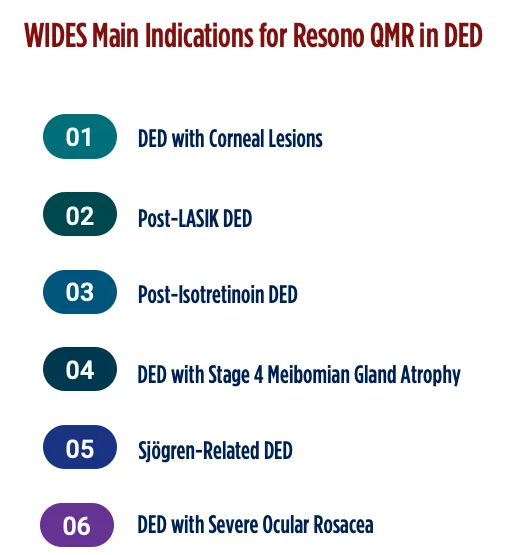
WIDES main indications for Resono QMR in DED
Based on current WIDES clinical experience and the available scientific evidence, Resono QMR is particularly considered in the following clinical situations:
DED with corneal epithelial lesions
Patients with clinically significant corneal epithelial involvement and fluorescein staining.
This is a major indication for QMR, now strongly supported by the 2026 network meta-analysis showing the highest efficacy of QMR for improvement in corneal staining.
Post-LASIK DED
Patients with persistent dry eye following LASIK, particularly when corneal surface abnormalities, epithelial stress, or staining remain clinically significant.
Post-isotretinoin DED
Patients presenting with persistent ocular surface disease and meibomian gland dysfunction following isotretinoin exposure.
DED with stage 4 meibomian gland atrophy
Patients with advanced structural gland loss, in whom purely gland-directed treatments may have limited potential because of the markedly reduced amount of residual functional glandular tissue.
Sjögren-related DED
Patients with aqueous-deficient and inflammatory dry eye associated with Sjögren disease, particularly when significant corneal epithelial damage is present.
DED with severe ocular rosacea
Patients with severe inflammatory and vascular ocular surface disease associated with ocular rosacea, particularly when corneal epithelial involvement accompanies the inflammatory component.
Treatment protocol
The randomized QMR trials included in the 2026 network meta-analysis used protocols based on four weekly treatment sessions.
One study compared four weekly QMR sessions with conservative treatment, while another compared four weekly QMR sessions with a low-power sham QMR protocol associated with artificial tears.
In clinical practice, treatment protocols should follow device-specific recommendations and be adapted according to:
- disease severity
- corneal involvement
- associated pathophysiological mechanisms
- clinical response
QMR may be used alone but is particularly valuable within a multimodal Interventional Dry Eye strategy.
QMR and combination therapy
A single patient may simultaneously present with:
- telangiectasia
- inflammation
- gland obstruction
- altered meibum
- gland atrophy
- tear-film instability
- corneal epithelial damage
No single technology addresses all of these mechanisms.
A rational therapeutic strategy may therefore combine:
- IPL vascular and inflammatory component
- Thermal Therapy / Meibomian Gland Expression obstruction and abnormal meibum
- QMR corneal epithelial involvement and non-thermal electrical bio-stimulation
- PBM or JETT when indicated complementary cellular or tissue mechanisms
The objective is therefore not to determine which technology is universally "best", but to determine which technology is best suited to each pathophysiological component of the individual patient.
QMR: a key component of Interventional Dry Eye
Within the WIDES treatment philosophy, QMR has acquired a particularly important position because it addresses an objective therapeutic endpoint that is central to ocular surface disease:
Corneal Epithelial Damage
Many technologies used in Interventional Dry Eye primarily target gland obstruction, meibum quality, vascular inflammation, or tear-film instability.
QMR adds a different therapeutic dimension by providing a non-thermal electrical approach associated with a marked improvement in corneal staining.
The 2026 evidence showing QMR as the highest-ranked intervention for this endpoint reinforces its position within the WIDES therapeutic strategy.
Interventional Dry Eye should not only improve the tear film. It should also address the ocular surface damage produced by the disease.
Clinical take-home message
QMR is a non-thermal electrical bio-stimulation technology with a particularly important role in dry eye patients with corneal epithelial involvement.
The 2026 systematic review and network meta-analysis by Noyman, Mimouni and colleagues ranked QMR first among evaluated technological treatments for improvement in corneal staining, with a P-score of 0.977.
QMR was also the only intervention significantly superior to conservative treatment for corneal staining in the network analysis.
The authors specifically suggest that this strong effect may reflect potential benefits in epithelial healing and inflammatory modulation through bioelectrical stimulation, while appropriately calling for further independent confirmation.
For WIDES, this ability to address corneal epithelial involvement makes QMR a key and increasingly indispensable component of the Interventional Dry Eye Concept.
Non-Thermal Electrical Bio-StimulationImproved Corneal StainingEpithelial RecoveryRestoration of Ocular Surface Homeostasis