Thermotherapies encompass a family of treatments designed to deliver controlled heat to the eyelids and meibomian glands in order to reduce the viscosity of abnormal or inspissated meibum and facilitate its evacuation.
Their principal indication is obstructive meibomian gland dysfunction (MGD), particularly when gland expression reveals cloudy, viscous, filamentous, or toothpaste-like secretions.
Thermotherapies directly target one of the fundamental mechanisms of obstructive MGD: abnormal meibum that has become difficult to evacuate.
They remain an important evidence-based component of modern dry eye management and are included among the device-driven eyelid-warming strategies reviewed in TFOS DEWS III.
How thermotherapies work
Normal meibum must remain sufficiently fluid to move through the meibomian ducts and reach the lid margin.
In obstructive MGD, changes in meibum composition and increased viscosity can impair this process.
Controlled heating aims to:
- soften and liquefy abnormal meibum
- reduce resistance to gland evacuation
- facilitate meibum flow
- improve gland expressibility
- allow more effective mechanical evacuation
- support restoration of the lipid component of the tear film
The effect of thermotherapy is therefore primarily thermal, functional, and mechanical.
Heat softens the meibum and Pressure or expression evacuates it.
This explains why many modern systems combine controlled heating with pulsation, compression, massage, or subsequent manual gland expression.
Thermotherapy is more than a warm compress
Traditional warm compresses remain useful in MGD, but their temperature, duration, and effective heat transfer to the meibomian glands may vary considerably.
Dedicated thermotherapy devices are designed to provide more standardized treatment through:
- controlled temperature
- reproducible energy delivery
- defined treatment duration
- targeted eyelid heating
Depending on the system, heating may then be associated with:
- automated pulsation
- controlled compression
- massage
- manual gland expression
Thermotherapies therefore provide a more controlled and reproducible approach to eyelid heating than conventional home warming alone.
LipiFlow
The historical reference in thermal pulsation
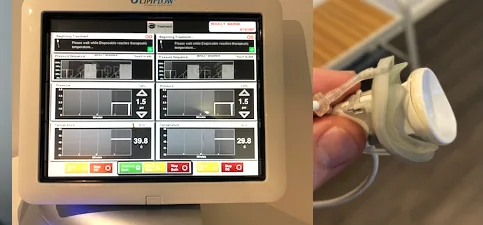
LipiFlow was one of the first dedicated in-office systems specifically developed to treat obstructive MGD through vectored thermal pulsation.
It has become the historical reference for this therapeutic concept and remains one of the most extensively studied thermotherapy systems in dry eye disease.
The system simultaneously applies: controlled heat to the inner eyelid surface and automated pulsatile pressure to the external eyelid with the objective of warming the meibomian glands while mechanically evacuating obstructed glandular contents.
This simultaneous inner-eyelid heating + external pulsation is the distinctive principle of LipiFlow.
Randomized studies have demonstrated improvements in gland secretion and symptoms following a single treatment, and LipiFlow has accumulated more than a decade of published clinical experience.
TearCare
Controlled external heating followed by gland expression
TearCare uses flexible external heating elements placed directly over the eyelids.
Unlike systems that immobilize the eyelids during treatment, TearCare allows the patient to blink naturally while the eyelids are being heated.
Once adequate heating has been achieved, the clinician manually expresses the meibomian glands.
The therapeutic sequence is therefore:
This approach combines standardized thermal treatment with direct clinician-controlled evacuation of the glandular contents.
Randomized comparative trials have demonstrated significant improvements in symptoms and meibomian gland function with both TearCare and LipiFlow.
iLux
Localized heating and compression under direct clinician control
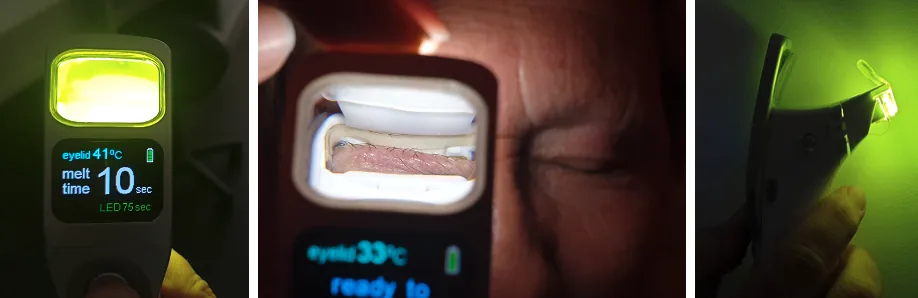
iLux is a handheld thermal pulsation system that allows the clinician to treat selected areas of the eyelids directly.
The device combines localized heating with controlled compression, allowing the operator to visualize and target specific meibomian gland regions.
The therapeutic sequence is:
Its handheld design provides direct control over both treatment location and mechanical gland evacuation.
Three major approaches to the same mechanism
LipiFlow, TearCare, and iLux use different technical solutions but share the same fundamental therapeutic objective:
Heat the glands and facilitate meibum evacuation
- LipiFlow
- Inner-eyelid heating + automated external pulsation
- TearCare
- External eyelid heating + natural blinking + manual gland expression
- iLux
- Localized heating + operator-controlled compression
These systems represent different ways of addressing the same major pathophysiological component: obstructive meibomian gland dysfunction.
Other thermotherapy systems
Several additional technologies use controlled heat or thermo-mechanical energy to address obstructive MGD.
Their mechanisms and levels of scientific evidence differ considerably.
MiBoFlo Thermoflo
External thermoelectric heating combined with manual massage
MiBoFlo delivers controlled external heat to the eyelids through a handheld thermoelectric probe while the clinician performs a gentle massage.
The objective is to warm the meibomian glands, soften abnormal meibum, and facilitate its subsequent evacuation.
Its therapeutic principle can be summarized as:
A prospective randomized controlled trial directly compared MiBoFlo with LipiFlow in patients with MGD and demonstrated improvement with both approaches.
MGrx
Thermal debridement, massage, and gland expression
MGrx takes a broader multimodal approach to eyelid treatment.
The handheld system incorporates dedicated heated attachments for three consecutive treatment steps:
Rather than using heat alone, MGrx integrates thermal energy into the mechanical treatment of both the lid margin and meibomian glands.
A randomized clinical trial compared MGrx with conventional debridement, warming, and gland expression. Both approaches produced sustained symptomatic improvement, with the MGrx system providing an integrated in-office treatment.
Tixel
Thermo-mechanical stimulation of the eyelids
Tixel differs substantially from conventional thermal pulsation systems.
It delivers a brief, controlled thermo-mechanical stimulus to the periocular skin through a heated metallic treatment surface.
Tixel should therefore be considered a thermo-mechanical technology, rather than simply another sustained eyelid-heating system.
Other eyelid-warming technologies
A number of other medical and home-based systems provide controlled dry or moist heat to the eyelids.
These include dedicated warming masks, thermostatically controlled devices, and chambered warm-moist-air systems.
Their ability to deliver and maintain effective temperatures at the meibomian glands varies considerably according to the device, heating method, treatment duration, and eyelid anatomy.
For WIDES, these devices should therefore be considered part of the broader thermotherapy spectrum, but should not automatically be assumed to have the same mechanism, treatment intensity, or level of clinical evidence as LipiFlow, TearCare, iLux, MiBoFlo, MGrx, or Tixel.
Different devices, one fundamental principle
Despite major technological differences, the principal therapeutic objective remains the same:
- LipiFlow
- Inner heat + automated pulsation
- TearCare
- External heat + manual expression
- iLux
- Localized heat + controlled compression
- MiBoFlo
- External heat + manual massage
- MGrx
- Thermal debridement + massage + expression
- Tixel
- Thermo-mechanical stimulation
The engineering differs. The amount of scientific evidence differs. But the central therapeutic target remains:
obstructive MGD with residual functional glandular tissue.
Why meibomian gland expression matters
Heating alone does not necessarily guarantee adequate evacuation of abnormal glandular contents.
The mechanical component of treatment is therefore important.
Depending on the technology, evacuation may occur through:
- automated pulsation
- controlled compression
- massage
- manual gland expression
The objective is not simply to increase eyelid temperature.
The therapeutic endpoint is not heat itself.
The therapeutic endpoint is improved meibum flow.
The importance of meibography before treatment
Thermotherapies can only act effectively on glands that remain structurally present.
For this reason, meibography should be integrated into patient selection, particularly in advanced MGD.
A patient presenting with: significant obstruction + abnormal meibum + preserved glands may be an excellent candidate for thermotherapy.
Conversely: advanced gland atrophy + very limited residual gland tissue reduces the potential benefit of a treatment whose principal objective is to improve evacuation from existing glands.
This distinction illustrates a central principle of Interventional Dry Eye:
Do not treat gland obstruction without first assessing how much glandular tissue remains.
Clinical indications
Thermotherapies are particularly relevant in patients with:
-
01
Obstructive MGD
Meibomian glands remain structurally present but their secretion is impaired by obstruction.
-
02
Thick or viscous meibum
Cloudy, viscous, filamentous, inspissated, or toothpaste-like secretion is observed during diagnostic gland expression.
-
03
Reduced gland expressibility
Meibum can only be obtained with progressively increasing mechanical pressure.
-
04
Evaporative DED associated with MGD
Impaired lipid-layer function contributes significantly to tear-film instability and excessive evaporation.
-
05
Patients requiring gland evacuation after heating
Particularly when diagnostic expression confirms retained glandular contents that remain potentially mobilizable.
Thermotherapies remain an important treatment option
The development of IPL, QMR, PBM, JETT, radiofrequency, and other interventional technologies has substantially expanded the therapeutic possibilities available for dry eye disease.
It has not eliminated the role of thermotherapy.
When clinically significant gland obstruction and abnormal meibum are present, controlled heating remains a logical and evidence-based therapeutic approach.
TFOS DEWS III continues to include device-driven eyelid warming among the in-office treatments used for MGD-related dry eye disease.
The appropriate question is therefore not: “Are thermotherapies still useful?” but rather: “Does this patient have an obstructive component that should be treated with controlled heating and gland evacuation?”
Thermotherapies within the Interventional Dry Eye Concept
Thermotherapies primarily address:
Gland obstruction and abnormal meibum
However, dry eye disease is frequently more complex.
The same patient may also present with:
- telangiectasia
- ocular rosacea
- inflammation
- gland atrophy
- tear-film instability
- epithelial damage
Thermotherapies should therefore not be expected to treat every component of DED.
Other interventions can be selected according to the individual pathophysiological profile.
- Thermotherapies
- Gland heating + reduction of meibum viscosity + evacuation
- IPL
- Vascular and inflammatory components
- Radiofrequency
- Controlled thermal energy delivered through tissue resistance
- QMR
- Non-thermal electrical bio-stimulation with particular interest in corneal epithelial involvement
- Photobiomodulation
- Photochemical cellular modulation
- JETT
- Controlled plasma effect or low-intensity electrical membrane modulation, depending on the applicator
- Meibomian gland expression
- Direct mechanical evacuation of obstructed glands
The WIDES approach does not oppose these technologies.
Each treatment targets a different pathophysiological mechanism.
Thermotherapy and combination treatment
In selected patients, thermotherapy can be incorporated into a multimodal therapeutic sequence.
For example:
- IPL
- addresses vascular and inflammatory abnormalities
- Thermotherapy
- softens abnormal and inspissated meibum
- Meibomian Gland Expression
- evacuates the softened glandular contents
Additional technologies may subsequently be used when epithelial, inflammatory, cellular, or other mechanisms remain active.
This illustrates a central principle of WIDES: one patient may require several complementary treatment mechanisms.
Clinical evidence
Thermal pulsation and controlled eyelid heating have been investigated for more than a decade.
LipiFlow remains the historical and most extensively documented dedicated thermal pulsation system.
TearCare and iLux have subsequently been evaluated in randomized comparative trials against LipiFlow.
TearCare has demonstrated significant clinical improvement in patients with MGD-related DED in randomized comparative studies.
iLux demonstrated non-inferiority to LipiFlow for major glandular, tear-film, and symptom outcomes over 12 months in a randomized multicenter study.
MiBoFlo has also been evaluated against LipiFlow in a randomized controlled trial.
MGrx has emerging randomized clinical evidence, while Tixel has encouraging prospective data but requires further randomized confirmation.
The evidence therefore supports the overall therapeutic principle of: controlled eyelid heating combined with effective gland evacuation for appropriately selected patients with obstructive MGD.
Safety
Thermotherapies should be performed using appropriate devices and according to device-specific protocols.
Important parameters include:
- treatment temperature
- duration of heating
- pressure applied to the eyelids
- ocular protection
- glandular anatomy
- patient comfort
- associated ocular surface disease
Treatment should be individualized according to both: the functional degree of obstruction and the structural status of the meibomian glands.
Clinical take-home message
Thermotherapies remain an important evidence-based treatment for obstructive meibomian gland dysfunction.
Their fundamental objective is to: soften abnormal meibum and facilitate its evacuation from glands that remain structurally viable.
LipiFlow remains the historical and most extensively documented reference in thermal pulsation, while TearCare and iLux provide alternative well-established approaches to controlled eyelid heating and gland evacuation.
MiBoFlo, MGrx, Tixel, and other warming technologies further expand the thermotherapy spectrum through different combinations of heat, massage, compression, debridement, expression, or thermo-mechanical stimulation.
Their technologies differ, and their levels of scientific evidence differ, but their principal indication remains essentially the same:
Preserved glands + Obstruction + Abnormal meibum