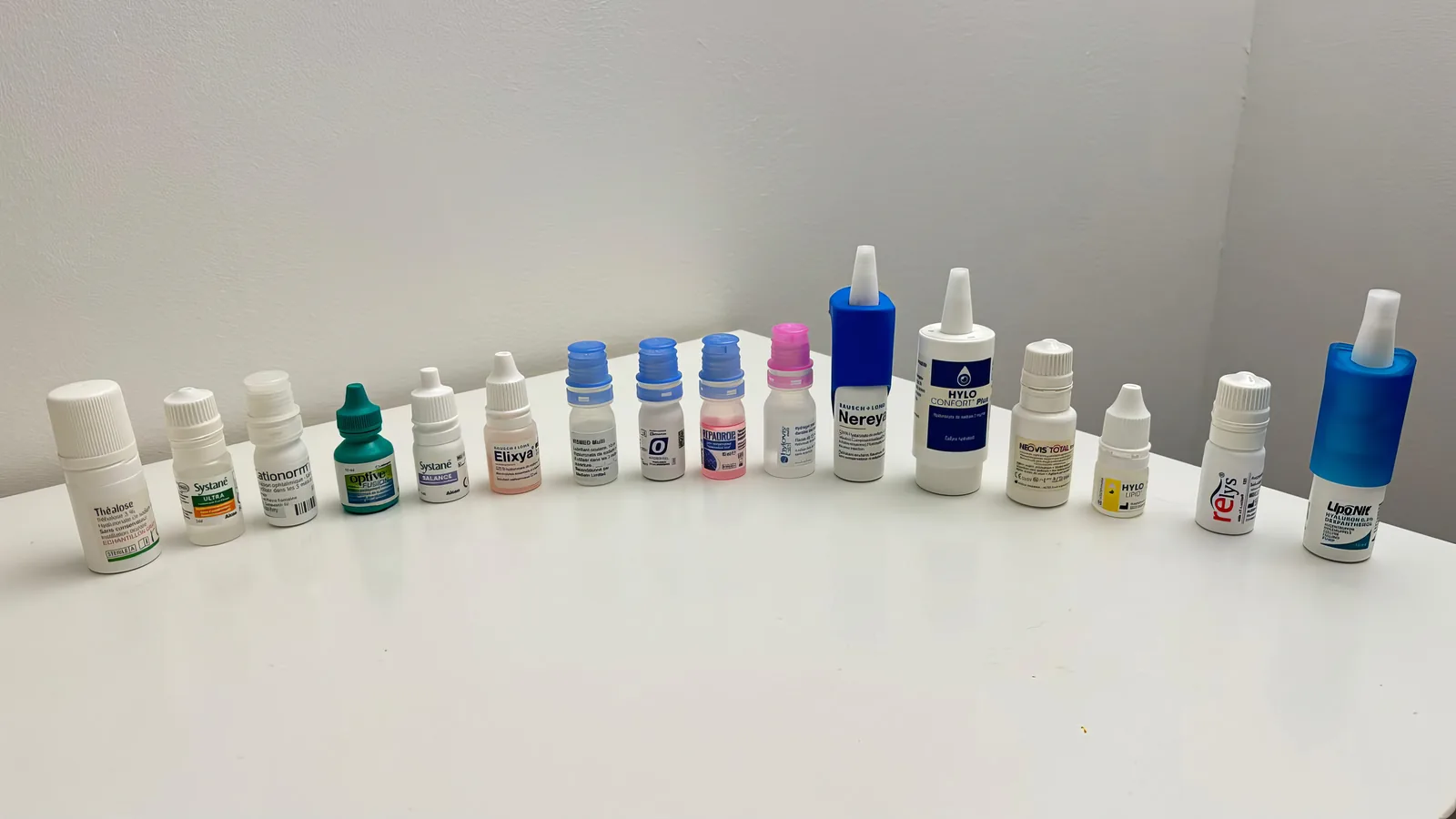
Lubricating eye drops and tear substitutes remain an essential component of dry eye disease (DED) management, including within the Interventional Dry Eye Concept.
Interventional technologies aim to target the underlying pathophysiological mechanisms of dry eye disease, but they do not replace the need to restore lubrication, reduce friction, protect the ocular surface, and support tear-film stability.
Lubricants are not an alternative to Interventional Dry Eye. They are an integral part of it.
They may be used before, during, and after interventional treatments and remain particularly important while the ocular surface is recovering and tear-film homeostasis is being restored.
Why lubrication remains essential
Dry eye disease exposes the ocular surface to increased evaporation, friction, hyperosmolarity, inflammation, and epithelial stress.
Lubricating eye drops can help by:
- improving ocular surface lubrication;
- reducing friction between the eyelids and ocular surface;
- increasing tear retention;
- improving tear-film stability;
- diluting inflammatory and hyperosmolar tear components;
- protecting the corneal and conjunctival epithelium;
- improving patient comfort;
- supporting epithelial recovery.
Their role is therefore both symptomatic and protective.
Interventional therapies target the mechanisms of disease. Lubricants protect the ocular surface while those mechanisms are being treated.
Not all lubricants are the same
The clinical effect of a lubricant depends largely on its formulation.
Different products may contain combinations of:
- Viscoelastic polymers
- Osmoprotectants
- Lipid components
- Humectants
- Mucomimetic agents
- Epithelial-protective compounds
The choice of formulation should therefore reflect the individual characteristics of the patient’s dry eye disease rather than relying on a single product for every patient.
Hyaluronic acid
Hyaluronic acid is one of the most widely used lubricant components in modern dry eye therapy.
Its viscoelastic and water-retaining properties help increase ocular surface residence time and improve lubrication.
Depending on its molecular characteristics and concentration, hyaluronic acid formulations may provide:
- prolonged hydration;
- improved ocular surface wettability;
- reduced friction;
- enhanced patient comfort;
- support for epithelial recovery.
Hyaluronic acid is particularly useful when ocular surface protection and prolonged lubrication are required.
Cellulose derivatives and viscoelastic polymers
Cellulose derivatives such as carboxymethylcellulose (CMC) and hypromellose (HPMC) remain important components of tear substitutes.
Other polymers may include:
- hydroxypropyl guar;
- polyvinyl alcohol;
- povidone;
- polyethylene glycol;
- propylene glycol;
- carbomer.
These agents increase viscosity and retention on the ocular surface to varying degrees.
More viscous formulations generally provide longer-lasting lubrication but may temporarily increase visual blur.
The formulation should therefore be adapted to the patient’s symptoms, severity, visual requirements, and frequency of use.
Osmoprotection
Hyperosmolarity is an important component of dry eye pathophysiology.
Some tear substitutes contain osmoprotective agents intended to help epithelial cells resist hyperosmolar stress.
Examples include compounds such as:
- L-carnitine
- Erythritol
- Betaine
- Trehalose
Their objective is not simply to lubricate the surface but also to help preserve cellular homeostasis in an adverse tear-film environment.
Lipid-based formulations
In evaporative dry eye and meibomian gland dysfunction, the lipid layer of the tear film may be deficient or abnormal.
Lipid-containing tear substitutes are designed to reinforce the superficial lipid layer and reduce excessive evaporation.
They may contain components such as:
- Mineral oils
- Phospholipids
- Triglycerides
- Other lipid emulsions
These formulations are particularly relevant in patients with:
- meibomian gland dysfunction;
- evaporative dry eye;
- abnormal lipid layer;
- excessive tear evaporation.
They complement, but do not replace, treatments directed at the meibomian glands themselves.
Preservative-free formulations
For patients requiring frequent or long-term instillation, preservative-free formulations should generally be preferred, particularly when the ocular surface is already compromised.
Repeated exposure to certain preservatives may contribute to epithelial toxicity, inflammation, and ocular surface intolerance.
Preservative-free formulations are especially important in:
- moderate-to-severe DED;
- frequent daily use;
- significant corneal or conjunctival staining;
- Sjögren-related dry eye;
- postoperative ocular surface disease;
- patients using multiple topical medications.
Matching the lubricant to the dry eye profile
The choice of tear substitute should be guided by the predominant clinical problem.
| Predominant clinical problem | Formulation to favour |
|---|---|
| Aqueous deficiency | Water-retaining and viscoelastic formulations |
| Evaporative DED / MGD | Lipid-containing formulations |
| Significant epithelial damage | Highly protective and preservative-free formulations |
| Hyperosmolarity | Formulations containing osmoprotective agents |
| High friction / lid wiper epitheliopathy | Prolonged lubrication and high ocular surface retention |
| Severe or complex DED | Combination strategies and more frequent preservative-free lubrication |
The objective is to select the formulation according to the pathophysiological profile and ocular surface needs of each patient.
Lubricants within the Interventional Dry Eye Concept
Lubricants occupy a permanent place in the WIDES therapeutic strategy.
They may be used alongside:
- IPL
- QMR
- JETT
- Photobiomodulation
- Radiofrequency
- Thermal Therapies
- Meibomian Gland Expression
- Lid Margin Debridement
Their role is complementary.
While interventional technologies target specific mechanisms such as inflammation, abnormal vascularization, gland obstruction, cellular dysfunction, or altered meibum flow, lubricants provide the ocular surface with continuous protection between treatment sessions.
This becomes particularly important when treatment aims to progressively restore ocular surface homeostasis over several weeks or months.
Before, during and after interventional treatment
Lubricants should not be reserved only for patients who have not undergone interventional treatment.
They remain useful throughout the therapeutic sequence.
- Before treatment To stabilize and protect the ocular surface while the pathophysiological profile is being assessed.
- During the interventional protocol To maintain lubrication and reduce friction between treatment sessions.
- After treatment To support epithelial recovery and maintain ocular surface protection while clinical improvement develops.
Interventional treatment may reduce the patient’s long-term dependence on frequent lubrication, but it does not make ocular surface protection unnecessary.
Clinical take-home message
Lubricating eye drops remain indispensable in the management of dry eye disease, including in patients undergoing modern interventional treatment.
Interventional technologies treat specific pathophysiological mechanisms, while lubricants provide continuous support to the tear film and ocular surface.
The two approaches should therefore not be opposed.
Lubrication + Pathophysiological TreatmentOcular Surface Protection + Restoration of Homeostasis
Within the WIDES Interventional Dry Eye Concept:
Accurate DiagnosisTargeted Interventional Treatment + Appropriate LubricationImproved Ocular Surface Homeostasis